Best Manitoba ATV Trails for Beginners
A first Manitoba ATV ride can go sideways before you even unload: a route that looks gentle on a map may hide mud, confusing junctions, or a seasonal closure. This guide helps new riders choose promising beginner areas, judge whether a trail suits their machine and experience, and plan a first outing without treating any route as guaranteed easy.
What makes a Manitoba ATV trail beginner-friendly
Look for a manageable route, not just an easy label
“Beginner-friendly” means more than a flat-looking line on a map. For a first outing, prioritize a route that is short enough to finish comfortably, has obvious junctions, offers places to stop, and does not require you to negotiate difficult terrain just to reach the easier section. A smooth, wide trail can still be stressful if it runs a long way from the trailhead or has several confusing forks.
Consider the experience of the least-confident rider in your group. Someone who is comfortable on a farm quad may still find a narrow bush trail unnerving, while a new UTV driver may need time to get used to the machine’s width and turning radius. Leave room for breaks and backtracking. A two-hour ride that goes smoothly is a better first experience than an ambitious all-day loop that becomes tiring halfway through.
Trail conditions can change a route’s difficulty quickly. A packed surface after a dry spell may become slippery or deeply rutted after rain. Muskeg, standing water, exposed roots, loose sand, and fallen branches can turn a straightforward route into a recovery exercise. For a first trip, choose conservative conditions and be willing to turn around rather than push through a section you do not like.
Match the route to your machine and your group
A trail that works for a narrow ATV may not suit a wide side-by-side. Check any available trail information for width restrictions, obstacles, steep sections, and shared-use rules before hauling out. If the information is vague, contact the local club or trail manager instead of assuming your machine will fit.
Think about passengers, too. A passenger can affect how a machine handles, and a new operator may need extra time to manage turns, braking, and uneven ground. Keep your first ride simple: one lead rider who knows the route, a modest group size, and no pressure to keep pace with experienced riders. For more on judging route difficulty, see [Manitoba Trail Difficulty Ratings].
Choose access you can confirm
In Manitoba, the fact that a trail appears on a map does not automatically mean it is open to every machine or available for riding at all times. Club routes, Crown land, private property, leases, and provincial parks can have different access rules. Check the land status and any local restrictions before you set out.
Provincial parks are especially important to verify carefully: machines are allowed only on designated routes, not wherever a track or road appears. Read [Manitoba Parks Allow Machines on Designated Routes Only] before planning a park ride. For a broader explanation of the difference between club corridors and other land, start with [Manitoba ATV Trails: Club Ground and Crown Land].
Manitoba areas worth considering for a first ride
The areas below are useful starting points for research, not promises that every section is easy or open. A local club’s current map and advice should determine your final route. If you are new, ask specifically for a short route with straightforward navigation and no known difficult crossings or wet sections.
Agassiz and the Eastman region
The Agassiz area is a sensible place to investigate if you want a club-trail setting and are prepared to plan around the route’s conditions. The wider Eastman region has riding opportunities that can suit different experience levels, but trail surfaces and layouts vary. A new rider should avoid choosing solely from a scenic description or a route’s total distance.
Before you go, look for a local trail map, confirm where you can park and unload, and ask which portions are appropriate for a first ride. A useful question is, “If we want a short, relaxed ride and need to turn around easily, which section would you recommend today?” The Eastman area overview at [Manitoba Eastman Riding Areas] can help you narrow your search.
Woodridge and Sandilands
Woodridge and the surrounding Sandilands riding area are worth researching for a first outing, particularly if you can get route guidance from the local club. Do not assume that every trail in a wooded area is equally suitable: sand, soft ground, bends, and changing conditions can make one section feel very different from another.
For your first trip, choose a known trailhead and a conservative out-and-back route rather than trying to connect unfamiliar trails into a long loop. Ask about recent rain, soft spots, and any routes that are better suited to experienced riders. Keep an offline map available, but treat local updates and posted signs as essential.
Belair and the Interlake
Belair Forest and other Interlake riding areas may appeal to riders looking for wooded scenery and a day trip from communities around Lake Winnipeg. The same caution applies here: forest roads and tracks are not automatically legal ATV routes, and trail conditions can vary by section. Confirm that your planned route is open to your machine and that you have permission to use the access point.
A beginner-friendly plan might mean riding a short, clearly marked segment, stopping for a break, and returning the same way. It does not need to mean covering the longest route available. Use [Manitoba Interlake Riding Areas] to explore the region, then check directly with the relevant club or land manager before loading your machine.
Duck Mountain and the Mossberry Trail
The Mossberry Trail is a recognizable option to investigate in the Duck Mountain area. It is a shared-use trail, so riders should expect to encounter other trail users and should not treat it as an ATV-only corridor. Its full length or overall reputation does not tell you whether a particular section will be comfortable for your group on a particular day.
For a first visit, check the route details and current conditions, then decide whether a short section suits your skill level. Ask about surface, water, visibility, and places where you can safely turn around. Review [Mossberry Trail Shares Ground With Horses and Hikers] for the shared-use considerations, and do not ride around closures or posted restrictions.
| Area to research | Why a beginner might consider it | What to confirm before leaving |
|---|---|---|
| Agassiz and Eastman | Club-trail information may help you choose a short route | Current conditions, trailhead access, route difficulty, and machine suitability |
| Woodridge and Sandilands | A local club may be able to recommend a conservative section | Soft sand or wet areas, route markings, and where to unload |
| Belair and the Interlake | Several regional areas make it possible to plan a shorter outing | Legal access, open routes, parking, and shared-use rules |
| Duck Mountain and Mossberry Trail | A known route to research for a carefully chosen section | Current conditions, shared users, designated access, and whether the section fits your group |
How to plan your first Manitoba trail ride
Check maps, permissions, and conditions before hauling
Start with a club map or other reliable route information, then confirm the exact trailhead and access rules. A line on an app can be out of date, cross land where riding is not permitted, or continue beyond the section you meant to ride. Use [Manitoba ATV Trail Map Downloads] as a starting point for map research, and cross-check the route with the relevant local club or land manager.
A mapping app such as onX Offroad can help you review route options and keep map information available while you are out, especially when mobile coverage is unreliable. Still, an app should be a planning aid, not proof that a route is open or legal. Check the map legend, route source, and any available closure information, and compare what you see with signs at the trailhead.
Conditions deserve a separate check. Rain, fire restrictions, maintenance, and seasonal access can affect whether a route is usable. Read [Manitoba Trail Conditions Before You Haul] before making a long drive. If information is unclear, call or message a local club rather than relying on an old social media post or a route someone rode last season.
Pack for a slower, more flexible ride
Bring the basics you would want if the ride takes longer than expected: water, weather-appropriate layers, a first-aid kit, a charged phone, and a paper or offline map. Tell someone where you plan to ride and when you expect to return. For a longer or more remote outing, consider how your group would respond to a breakdown or a stuck machine before you leave the trailhead.
Keep your first ride modest. Choose a turnaround point in advance, and agree that anyone can call for a break or ask to head back. New riders often feel pressure to keep moving when the group is having fun, but fatigue and discomfort make decisions harder. Taking an early break is easier than managing a problem after everyone is tired.
If you use onX Offroad or another mapping tool, save the route information before losing cell service and make sure more than one person knows how to read it. Do not let a phone become your only navigation plan. Batteries drain, devices get wet, and a route may not show local closures or permission details.
Ride considerately on shared trails
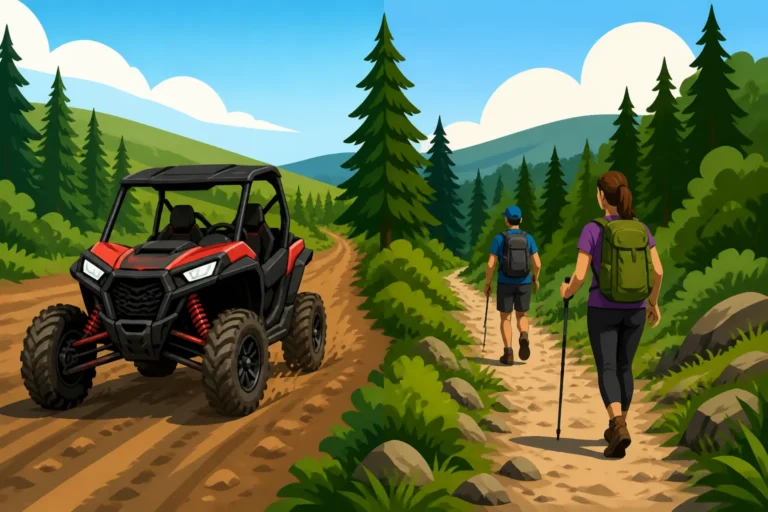
Beginner riders benefit from a calm pace, but courtesy matters just as much as control. Slow down when visibility is limited, give other trail users room, and follow any posted signs. On shared corridors, be especially alert for hikers, horses, and other riders. See [Manitoba Trail Etiquette Locals Expect] for practical ways to avoid creating problems for other users or the club maintaining the route.
Stay on the marked route and avoid cutting corners around mud or obstacles. Riding around a wet section can widen the trail and damage nearby ground; it can also take you onto land where you do not have permission to ride. If a section looks beyond your ability, stop in a safe place, talk it through, and turn back if needed.
A practical first-ride checklist
Before you load the machine
- Choose a short route or out-and-back section rather than committing to a long loop.
- Confirm the route is open and legal for your machine.
- Ask a local club about current conditions and beginner-suitable sections.
- Check trailhead access, parking, and unloading arrangements. [Manitoba Trailheads With Trailer Parking] can help you think through that part of the plan.
- Download or save maps for offline use and bring a backup navigation option.
- Tell someone your route and expected return time.
At the trailhead and on the route
- Read posted signs and confirm you are at the intended access point.
- Review the route with your group before starting.
- Ride at a pace that lets everyone stay comfortable and in control.
- Stop before difficult terrain rather than entering it just to see what happens.
- Turn around if conditions, access, or your group’s confidence do not match the plan.
- Leave gates, trail surfaces, and shared-use areas as you found them.
A good first ride is not measured by distance or by how many difficult obstacles you conquer. It is the one where you return with energy left, a clear sense of what your group enjoyed, and enough confidence to plan the next outing. For riders near the capital, [Manitoba Riding Near Winnipeg] is another useful place to begin comparing potential day trips.
Disclaimer
This article is for general informational purposes only and does not constitute professional advice. Laws, prices and regulations vary by location and change over time. Consult a qualified professional for guidance on your specific situation.