Manitoba Snow Lake Club Trails
Planning an ATV or UTV ride around Snow Lake takes more than choosing a trail on a map. Northern Manitoba’s distances, changing ground conditions and patchy cell service can turn a casual outing into a demanding day. This guide explains how to prepare for Snow Lake club trails, check local access, choose sensible equipment and ride with care in a remote area.
What to know about Snow Lake club trails
Club trails are local routes, not a guarantee of open access
Snow Lake is a northern Manitoba community, and the local ATV club is the best starting point for understanding its riding network. Club trails can make it easier to explore the area, but a line shown on an old map or saved on a phone does not automatically mean the route is open, maintained or available to every rider. Access may depend on the land, the season, recent weather, active work and local guidance.
Before unloading, try to confirm which routes are suitable for your machine and whether there are temporary closures or cautions. A trail may have soft ground, a blocked section or a bridge or crossing that is not appropriate for a larger side-by-side. Ask the club or a local contact about current conditions rather than relying on another rider’s post from a previous season.
It also helps to distinguish a club trail from a road, a private track or an informal route. Permission to ride one does not necessarily grant permission to use another. For a broader view of riding options across the region, [Manitoba Northern Riding Areas] can help put Snow Lake in context, while [The Snow Lake ATV Club's Northern Trails] is a relevant place to look for local trail information.
Confirm access before you make the drive
A long drive with a trailer makes last-minute uncertainty especially frustrating. You may arrive ready to ride only to find that a route is closed, the staging area is unsuitable for your trailer, or the ground has become difficult after rain. Make a quick pre-trip check: contact a local club representative if possible, review any available trail notices, and ask whether there is a recommended place to unload.
Clarify the basics before you leave home: which route is open, whether a side-by-side can use it, where riders typically stage, and whether any sections need special caution. If you are travelling with a group, ask about narrow trail sections, turnaround options and whether a long machine or trailer will be a poor fit. These details can prevent a small uncertainty from becoming a complicated recovery.
Keep in mind that local advice is useful, but conditions can change between the time you ask and the time you arrive. Treat signs at the trailhead and instructions from land managers as important, and be prepared to change plans. For broader trip-planning help, [Manitoba Trail Conditions Before You Haul] covers the kinds of checks worth making before towing to a riding area.
Plan for distance, navigation and limited service
Build a route plan that works without cell coverage
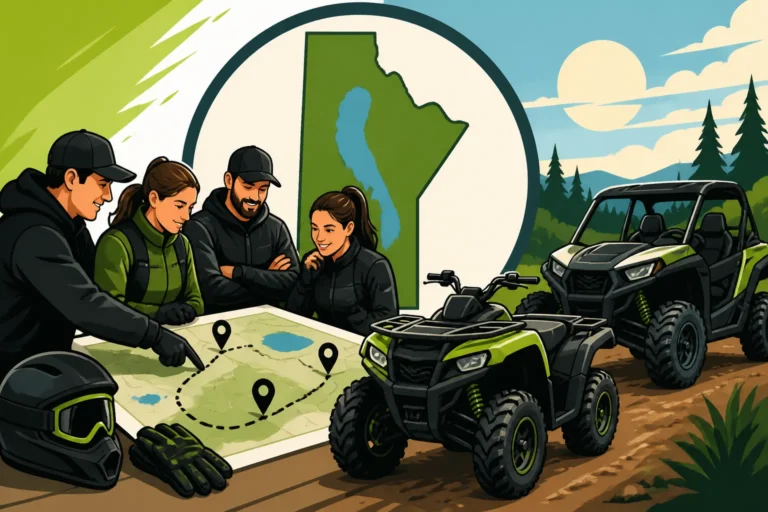
Northern rides can take you beyond reliable phone reception. That does not mean every Snow Lake trail has no service; it means you should not make safe navigation depend on having a signal. Download relevant maps before setting out, charge your phone and carry a paper map or other backup that you can use if your battery dies or your screen becomes difficult to read.
Before you start, tell someone where you intend to ride, who is in your group and when you expect to check in. Agree on a simple plan for what happens if riders become separated or delayed. In a group, decide who leads and who stays at the back, and stop at planned points so the group can regroup rather than stretching out over unfamiliar ground.
A digital mapping app such as onX Offroad can be one part of a navigation setup, especially if you prepare maps before losing service. Check the app’s coverage and available map detail for the area before relying on it, and do not treat an app’s displayed line as proof that a route is open or that you have permission to ride there. Pair it with local information, signs and a backup map. [Manitoba Trail Apps and Maps] and [Carrying a Paper Map in the Manitoba Bush] are useful related reads.
Give the group enough time and supplies
A route that looks short on a screen may take longer than expected when the ground is rough, riders stop often or a machine needs attention. Start with a conservative plan, especially if nobody in the group knows the trail network. Leave room for navigation pauses, breaks and a slower pace for less experienced riders. Reaching a turnaround point with daylight and fuel to spare is better than pressing on because the group feels committed.
Bring water, food, basic first aid supplies, appropriate clothing and the tools needed for your machines. A spare belt may be useful for some UTVs, while a tire repair kit, pump and basic hand tools can help with common trail problems. The right kit depends on your machine and route, so check the owner’s manual and consider what you could realistically fix away from a shop.
Set a clear fuel plan before leaving. Know your machine’s practical range under the riding conditions you expect, not just its best-case range on easy ground. Mud, deep snow, low gears, heavy loads and frequent stops can all affect consumption. If the route or available services are unfamiliar, carry a suitable reserve and do not assume that fuel will be available at the trailhead. For remote-area planning, [Cell Dead Zones in Northern Manitoba] offers another useful reminder to prepare before reception disappears.
Choose a machine and setup for the ground
Match your route to your ATV or UTV
An ATV and a UTV can both be useful on northern trails, but size and capability matter. A narrower ATV may be easier to place on a tight route, while a side-by-side offers seating and storage benefits for some groups. That extra width, weight and length can also make a narrow, rutted or soft section harder to navigate. A route that feels comfortable for one machine may not suit another.
Ask about the trail’s character before deciding what to bring. Find out whether riders have reported tight turns, rough approaches, soft ground or sections that are unsuitable for a larger vehicle. If you do not get a clear answer, choose a modest route and be ready to turn around. Avoid following a smaller machine into a section simply because it has already passed through; its tires, clearance and weight may differ from yours.
Before the trip, check tires, brakes, steering, lights, battery and fluid levels. Secure loose cargo, confirm that any passenger seating and restraints are used as designed, and check that the machine’s protective equipment is in place. A pre-ride inspection is less exciting than loading up, but it is far easier to find a loose connection or damaged tire at home than halfway along an unfamiliar route.
Expect changing ground and protect your machine
Northern Manitoba conditions can vary across a single ride. A firm track may lead into wet or uneven ground, and a dry-looking section can hide soft spots. Riding too fast for visibility or conditions raises the chance of striking an obstacle, sliding into a rut or damaging the trail. Keep a pace that gives you room to react, and do not assume a route is safe simply because it was passable on your last visit.
Avoid forcing a machine through a bog or water crossing when you cannot judge the depth or bottom. A stuck machine can be difficult to recover, and a poorly planned attempt may damage the trail or put people at risk. If the route looks beyond the machine or group’s ability, stop and choose another way. A winch can be helpful equipment, but it is not permission to attempt every difficult section; recovery points, safe positioning and clear communication matter.
After the ride, remove mud and debris, especially around the radiator, suspension and moving parts. Inspect the machine for damage before hauling it home. If you have been through sensitive wet ground, keep to established routes and avoid creating new tracks. [Manitoba Muskeg and Machines] offers related guidance on why soft northern ground deserves particular care.
Ride responsibly and respect local access
Follow signs, permission requirements and trail etiquette
A club trail is shared space. You may encounter other ATV and UTV riders, hikers, horses, work vehicles or people accessing nearby properties. Slow down when visibility is limited, keep to the established route and give other users room. On narrow ground, communicate calmly and avoid rushing past someone who may be startled or unable to move safely.
Do not assume that a trail crosses land you can enter freely. Private land and Crown land can have different access requirements, and a Crown lease may involve an occupier whose consent is needed. Follow posted signs, gates and local instructions. If you are unsure who manages a section, ask before riding rather than treating an open-looking track as an invitation.
Noise and dust can affect people living or staying near a route. Ease off near homes, cabins and other users, and avoid spinning tires or creating unnecessary ruts. Pack out food wrappers, broken parts and any other waste you bring in. Local trust is part of what keeps riding opportunities viable: a considerate group is more likely to be welcomed back than one that leaves damage or conflict behind. See [Manitoba Trail Etiquette Locals Expect] for more on sharing trails respectfully.
Check rules that apply to your machine and route
Trail permission is only one part of planning. Manitoba’s operating rules can apply to off-road machines in ways riders do not always expect, and municipal rules or site-specific restrictions may affect where you can ride. Confirm the requirements that fit your machine and intended route, including registration, insurance, helmet use, age restrictions and any rules for crossings or road shoulders.
Do not treat a trail map as a legal guide. It may show a route without explaining who maintains it, whether access is currently permitted or which operating rules apply. Check official signs and seek clarification from the appropriate local authority when a route connects with a road, crosses another managed area or passes near private property. A quick question before the ride is easier than sorting out a misunderstanding on the trail.
Keep required documents available and make sure every rider understands the group’s plan. If someone is visiting from outside Manitoba, they should check how their home registration and insurance apply, as well as Manitoba’s operating rules. Riders should also agree that anyone who feels uncomfortable can ask the group to slow down or turn back. A good day does not depend on completing the longest possible route.
Compare your options before heading out
A useful plan balances the kind of ride you want with local conditions and the needs of your group. The table below is a starting point, not a substitute for a current trail check.
| Planning choice | What it may suit | What to check first |
|---|---|---|
| Short out-and-back ride | First visit, mixed-experience group or uncertain conditions | Turnaround space, route access and expected ground conditions |
| Longer day ride | Riders familiar with their machines and prepared for delays | Fuel range, daylight, navigation backup and check-in plan |
| ATV-focused route | Narrower machines or riders seeking a more compact setup | Trail width, obstacles and whether the route is open |
| UTV outing | Groups needing seats or more storage | Width, turning space, terrain suitability and passenger restraints |
| Ride with local guidance | Visitors unfamiliar with the area | Meeting point, route expectations and any group requirements |
| Independent navigation | Experienced riders with reliable preparation | Offline maps, paper backup, permissions and emergency plan |
Use mapping tools as support, not permission
A mapping app can make it easier to follow a planned route, mark a stopping point or share a location with your group. Apps such as onX Offroad may be useful for those tasks if the relevant map information is available for your area and downloaded ahead of time. Check the app before leaving, rather than discovering at the trailhead that you cannot access the map you expected.
It is important to understand what a map can and cannot tell you. A displayed track may be outdated, may reflect a route recorded by another user or may not show a closure. It does not replace permission from a landholder, club or managing authority. Use the app as a navigation aid alongside current local guidance, signs and a route plan. [Manitoba Trail Map Downloads] can also help you think about map preparation.
If you use onX Offroad, test the map and location functions before the trip and make sure every rider knows how to read the group’s chosen map. Keep enough battery for the ride, and consider a power bank stored securely and protected from moisture. If a digital map stops working, the group should still know how to pause, regroup and retrace a safe route.
Make the first ride deliberately conservative
For a first visit, resist the urge to plan the biggest loop you can find. Choose a route length and difficulty that leave room for uncertainty. If the first stretch is rougher than expected, turn around before the group is tired or low on fuel. That decision is not a failed ride; it is good judgement, particularly when you do not yet know how the trails behave.
Afterward, note what you learned: how long the route took, where the group stopped, which gear proved useful and whether the machine setup worked well. Keep those notes for the next outing, but do not assume that last trip’s conditions will repeat. Seasonal changes, rain and local work can alter the riding experience.
A thoughtful Snow Lake outing begins with local information and ends with the same care. Check access, prepare for limited service, bring suitable equipment and leave the trail as you found it. To compare timing and seasonal considerations with other riding plans, see [Manitoba Riding Season Month by Month] and [Manitoba Wildlife on the Trail].
Disclaimer
This article is for general informational purposes only and does not constitute professional advice. Laws, prices and regulations vary by location and change over time. Consult a qualified professional for guidance on your specific situation.