Manitoba Trails Shared With Horses
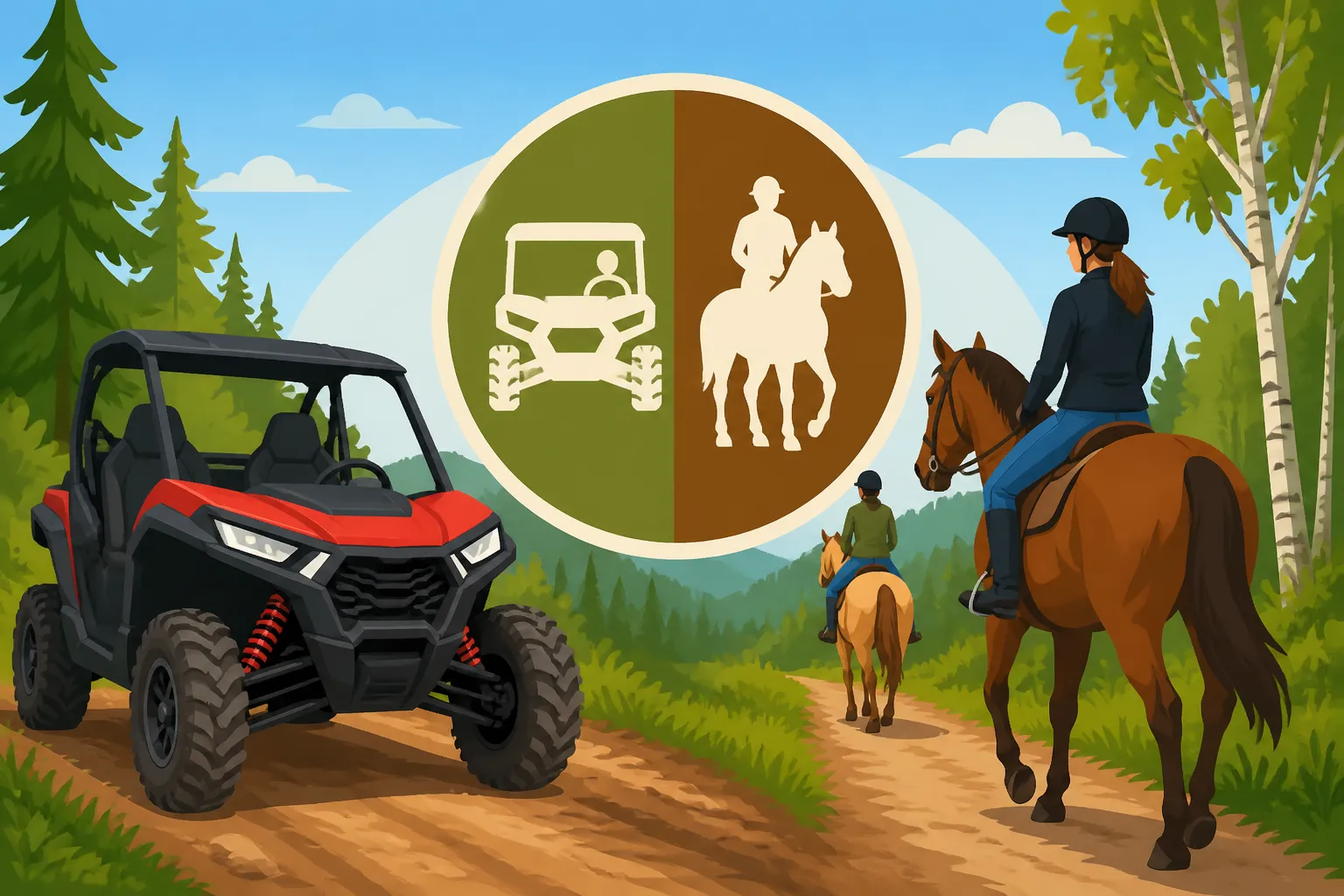
A quiet trail can change quickly when a horse and rider appear around a bend. The engine noise, narrow track and limited sightlines can make an ordinary pass feel tense for everyone. This guide explains how to prepare for shared-use trails in Manitoba, approach horses calmly, yield safely and check whether motorized riding is permitted on a route before unloading.
What shared trails mean for Manitoba riders
Shared use does not mean every trail is open to ATVs
A trail being used by horseback riders does not automatically make it open to ATVs or UTVs. Access depends on the specific route, land manager and any applicable restrictions. A path may be designated for certain activities, closed to motorized vehicles, or open only under conditions that change with season, maintenance or local rules.
That distinction matters when you are planning a ride. A track visible on a map, a worn path beside a road or a route used by horses is not, on its own, proof that off-road vehicles are allowed. In provincial parks, motorized machines are generally limited to designated routes, so check the park’s current rules and map before you set out. [Manitoba Parks Allow Machines on Designated Routes Only]
Club trail information can also help clarify who maintains a route and what kind of use it is intended to support. Ask the local club or land manager if the map does not clearly identify motorized access, or if a trailhead sign seems to conflict with what you have downloaded. [Manitoba Club Trails and Who Maintains Them]
Check permission, closures and local conditions
A route can cross different kinds of land, and access rules may differ from one section to the next. On private property, get the landowner’s permission where required; on Crown land, check whether access is allowed and whether a lease or other restriction applies. Do not assume that a route remains open simply because it was accessible on a previous ride. [Manitoba Crown Land Riding Explained]
Before hauling your machine, check trail notices, park information, club updates and signs at the access point. Look for closures, construction, seasonal limits, fire-related restrictions and warnings about soft or damaged ground. A route may also be open to motorized traffic but temporarily unsuitable after heavy rain, when tires can deepen ruts and cause damage.
Mapping tools can help with planning, especially when you are trying to understand where a route goes or where it meets another trail. Riders may use onX Offroad as one reference while reviewing an area, but treat any app as a planning aid rather than permission to ride. Compare what you see with signs and information from the land manager or club, and turn around if access is unclear. [Manitoba Trail Apps and Maps]
Preparing for a trail shared with horses
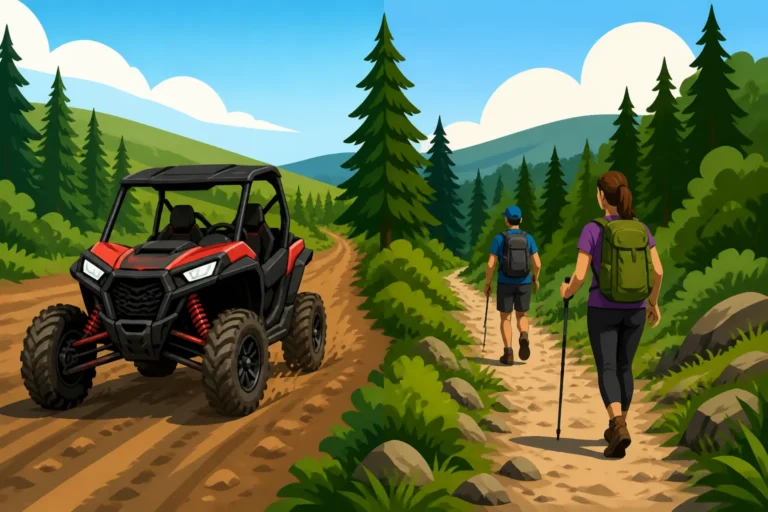
Plan for narrow paths and limited visibility
Horse riders may be travelling at a walking pace, and the horse may not be able to see you around a blind corner or through dense brush. A fast approach can startle both horse and rider, even if you intend to stop. On a shared route, ease off the throttle well before a bend, crest or tight section where someone could be approaching from the other direction.
Keep your speed low enough that you can stop smoothly without skidding or lurching. That is especially important on loose gravel, wet soil, steep grades and narrow bridges, where a sudden brake or throttle change can make your machine harder to control. If your group is spread out, let riders behind you know when you have spotted a horse so nobody rushes forward.
Build extra time into the ride rather than treating an encounter as an interruption. A short wait on a safe, wide spot is usually less stressful than trying to squeeze past on a narrow trail. If the route is too tight for a comfortable pass, be patient and let the horse and rider reach a wider area.
Make your machine less startling
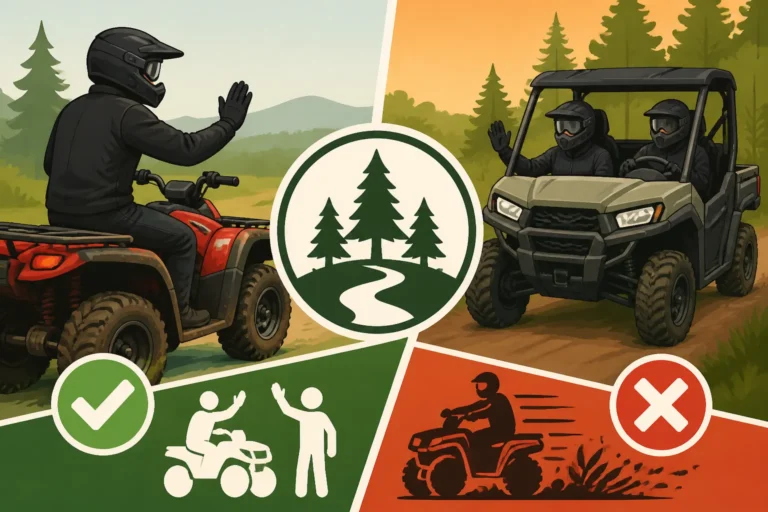
As soon as you see a horse, slow down early and make your presence clear without shouting or revving. A calm, friendly greeting gives the rider a chance to notice you and tell you what would help. Avoid accelerating to “get past quickly,” blipping the throttle, or riding close behind the horse; a sudden engine note can be frightening even when the machine is operating normally.
If the rider asks you to stop, stop. If they ask you to switch off your engine, do so when it is safe and practical. Stay in place until the rider indicates that it is okay to proceed. Horses respond differently, and the person handling the animal is usually best placed to judge how it is reacting.
Be prepared to wait with your machine steady and quiet. Do not make a tight turn or move toward the horse to create space unless the rider directs you; an unexpected movement can make the animal more nervous. When you do continue, ease away gently and leave plenty of room. [Manitoba Trail Etiquette Locals Expect]
How to pass a horse safely
Stop, communicate and follow the rider’s direction
When you meet a horse, the safest first move is usually to slow down and stop at a distance that gives the rider room to assess the situation. Avoid blocking the full trail if you can pull onto a firm, stable shoulder without damaging vegetation or entering a ditch, wet area or private property. Keep your machine pointed in a predictable direction and leave the rider a clear path.
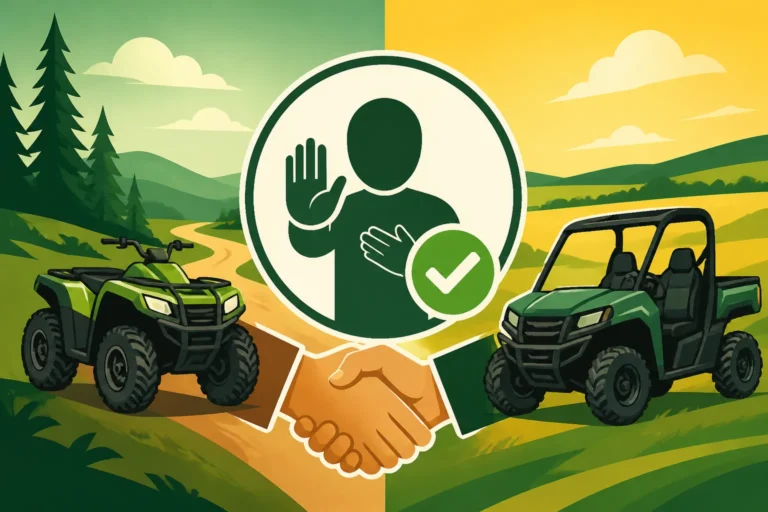
Speak in a normal, calm voice so the rider knows where you are. Ask whether they would prefer you to wait, shut off the engine or move to a particular side. Do not assume that every horse will react the same way. Some may remain settled around machines; others may be uneasy, especially if the noise is unexpected or the trail is confined.
Give the rider time to answer and guide the pass. If they say the horse is nervous, remain stopped and quiet. A rider may choose to lead the horse past your machine or wait for your group to move. Either way, let them set the pace rather than trying to finish the encounter quickly.
Yield on a narrow trail and pass only when there is room
A narrow trail is not a good place to squeeze by a horse. If you cannot leave a comfortable gap, wait for a wider and more stable section. Do not edge a large UTV close to the horse just because the machine technically fits; the animal may shy sideways, and the rider needs room to stay in control.
When the rider indicates that you can pass, do so slowly and steadily, without sudden throttle or steering inputs. Avoid passing so close that the machine, tires, mirrors or any attached equipment come near the horse. Once you are clear, continue at a low speed until you are well away rather than immediately accelerating.
If the horse is coming toward you, follow the rider’s instructions and give them room to choose a safe line. Do not force the animal toward the edge of a steep drop, ditch or unstable slope. For more guidance on meeting other trail users in tight spaces, see [Yielding on a Narrow Manitoba Trail].
| Situation | A safer response | Avoid |
|---|---|---|
| Horse appears ahead around a bend | Slow down early, stop at a safe distance and speak calmly | Rushing forward or revving to announce yourself |
| Trail is too narrow to pass | Wait for a wider spot and ask the rider what they prefer | Squeezing by or pushing the horse toward the edge |
| Rider asks you to shut off the engine | Switch it off when safe and wait for their signal | Restarting or moving before the rider is ready |
| Your group is travelling together | Keep riders spaced, communicate the encounter and pass one at a time | Crowding the horse with several machines at once |
| The route or access is unclear | Stop and check signs or ask the land manager or club | Assuming a visible track is open to motorized use |
Adjusting your group ride around equestrians
Keep the group calm and easy to manage
A group of several machines can feel much louder and larger to a horse than one stopped ATV. When the lead rider spots equestrians, they should signal the group to slow down and leave space between machines. Do not bunch up behind the person at the front; a cluster of idling engines can add pressure when the horse is already trying to understand what is happening.
Pass one machine at a time only when the rider says it is safe and there is enough room. The lead rider can go first, then pause farther ahead so the next person has a clear route without creating a wall of machines beside the horse. If the rider prefers that the whole group wait, stay patient and keep noise to a minimum.
A responsible group leader should brief everyone before the ride, especially guests who are unfamiliar with shared trails. Agree on a simple signal for stopping and make sure the last rider knows not to close the gap when the group encounters a horse. On a busy ride, that small bit of coordination can prevent several machines from appearing suddenly around a corner.
Choose routes and timing thoughtfully
When possible, select a route that is clearly open to motorized use and that offers enough width and visibility for different trail users to pass safely. If you know a trail is heavily used by horses, consider riding at a quieter time or choosing another permitted route. The goal is not to avoid equestrians entirely; it is to reduce surprise and give everyone room to share the trail.
Before leaving, look for information from the local club about trail conditions and access. A route that is easy to manage when dry may become narrow or fragile when muddy, and a closure or temporary restriction can affect your planned loop. [Manitoba Trail Conditions Before You Haul]
If horseback riders are part of your group or local trail community, ask them which sections are especially tight, busy or sensitive. Local knowledge can be more useful than a broad map when it comes to identifying a blind corner, a narrow crossing or a spot where a horse may need extra space. Keep any advice in context, though: conditions and access can change, so still follow posted signs and official route information.
Protecting the trail and responding to problems
Leave room without damaging the trail edge
Moving aside should not mean driving into fragile ground. A wet shoulder, ditch, stream edge or patch of vegetation may look like an easy place to wait, but tires can leave deep ruts and make the route harder for everyone. Choose a firm, safe place to stop when one is available, and do not cut around a horse through an area that is not part of the permitted route.
Shared trail etiquette includes respecting the ground as well as other users. Avoid spinning tires, widening the path or leaving litter. If you notice fresh damage, a hazard or a sign that access has changed, take a note of the location and report it through the appropriate club or land manager. [Reporting Trail Damage to a Manitoba Club]
If a horse or rider appears distressed, give them space and follow their directions. Do not attempt to touch the horse, take a close look at tack or offer to help unless the rider asks. A well-meant approach can add stress, while a calm, quiet pause gives the rider a chance to settle the animal and move on safely.
Respond calmly when an encounter goes wrong
Sometimes a horse may startle despite a careful approach. If it does, stop moving, keep the machine steady and give the rider room to regain control. Do not chase after the horse, crowd the rider or make a sudden attempt to pass. If the rider needs help, wait for clear direction before approaching.
If your machine stalls or you need to restart it, tell the rider what you are doing first if you can. A sudden restart can be startling, particularly when the horse is close. If the rider asks you to remain stopped, do so until they have moved to a safe distance or have told you to continue.
After a difficult encounter, consider whether your group’s speed, spacing or route choice contributed. Share the lesson with the rest of the group and adjust the plan for the return ride. For a broader look at how different users share Manitoba paths, [Manitoba Trails Shared With Hikers] offers another useful perspective. And before you head out, remember that trail access and etiquette are only part of the picture: confirm the route is open to your machine and follow applicable riding rules. [Manitoba ORV Road Rules Explained]
Disclaimer
This article is for general informational purposes only and does not constitute professional advice. Laws, prices and regulations vary by location and change over time. Consult a qualified professional for guidance on your specific situation.