Manitoba Registration Without a Bill of Sale
It's a common scenario in Manitoba: you've acquired an ATV or UTV, perhaps from a family member, a friend, or an older machine where the original paperwork has simply vanished over time. The problem? When you head to an Autopac agent to register your off-road vehicle with MPI, they're going to ask for proof of ownership, and a traditional bill of sale might be conspicuously absent. This guide is here to walk you through the process of registering your off-road vehicle in Manitoba when you don't have that standard bill of sale, ensuring you can still get out on the trails legally and safely.
The Importance of a Bill of Sale and When It Goes Missing
A bill of sale might seem like a simple piece of paper, but for registering an off-road vehicle (ORV) in Manitoba, it's often the cornerstone of proving ownership. When you purchase an ATV, UTV, or even a snowmobile from a dealer, they'll always provide you with a comprehensive bill of sale detailing the machine, the purchase price, and both parties' information. This document makes the registration process straightforward at any Autopac agent.
However, life isn't always so neat and tidy. Many Manitobans find themselves in possession of an ORV without this crucial document for a variety of reasons. Maybe you inherited your uncle's trusty quad, or a friend gifted you their old side-by-side when they upgraded. Perhaps you picked up an older machine at a farm auction years ago, and the original paperwork got lost in a move. Or, in a less ideal scenario, you might have purchased from a private seller who wasn't diligent about providing proper documentation, or perhaps they simply didn't have it themselves from their own purchase.
Whatever the reason, arriving at an Autopac agent without a bill of sale can feel like hitting a roadblock. MPI needs to ensure that the machine is legitimately yours, that it hasn't been stolen, and that any applicable taxes are collected. Without that standard proof of purchase, you'll need to prepare alternative documentation to satisfy their requirements. This is where understanding your options becomes incredibly valuable.
Why MPI Needs Proof of Ownership
Manitoba Public Insurance (MPI) acts as the registrar for all off-road vehicles in the province. Their role extends beyond just issuing a plate; they are also responsible for verifying legal ownership, ensuring the vehicle isn't reported stolen, and collecting the provincial sales tax (RST). This process safeguards both the buyer and the seller. Without proper documentation, it's impossible for them to confirm these critical details, which is why a missing bill of sale triggers a more in-depth review.
Common Scenarios for Missing Paperwork
Let's dig into some specific situations where you might find yourself without a traditional bill of sale:
- Inherited Machines: When an ORV passes to you as part of an estate, there might not be a "sale" in the traditional sense, and therefore, no bill of sale. You'll typically need documentation like a will, letters of administration, or a statutory declaration from the executor. You might want to refer to [Manitoba Registration After the Owner Dies] for more specific guidance on this.
- Gifts: If someone has given you an ORV, it's not a sale, so a bill of sale isn't generated. In this case, a letter from the giver confirming the gift, along with their information and the machine's details, can be helpful.
- Older Machines: Many older quads or dirt bikes have passed through multiple hands, and the original bills of sale or even prior registration documents might be long gone. This is particularly common with machines that were used strictly on private land and never registered.
- Private Sales Without Due Diligence: Unfortunately, not all private sellers are aware of or adhere to the proper transfer of ownership procedures. Sometimes, a handshake deal happens without any formal paperwork, leaving the buyer in a tough spot. To prevent this, even for a private sale, consider drafting a simple bill of sale using a resource like LawDepot to protect both parties.
- Auction Purchases: While some auctions provide formal invoices, others, particularly smaller farm auctions, might provide less formal receipts that don't meet MPI's specific bill of sale requirements. If you bought your machine at one, checking [Manitoba Registration for an Auction Buy] could offer more tailored advice.
Essential Documents When a Bill of Sale Is Absent
When you don't have a conventional bill of sale, MPI still needs to establish a clear chain of ownership and confirm the machine is truly yours. This means you'll need to gather alternative documents. The most critical among these is often a statutory declaration or affidavit of ownership.
The Statutory Declaration (Affidavit of Ownership)
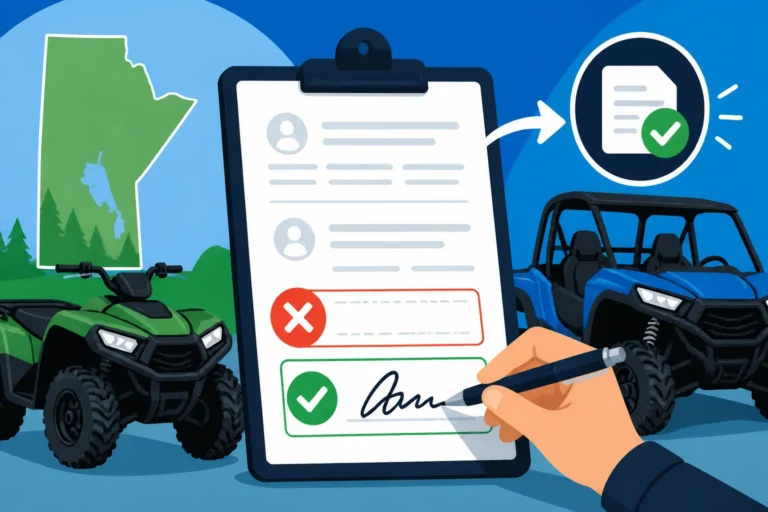
This is perhaps the most important document you'll need when a bill of sale is missing. A statutory declaration is a formal written statement of facts, which the person making the declaration swears or affirms to be true before an authorized official, like a Commissioner for Oaths or a Notary Public. It's essentially a legally binding declaration of your ownership.
What to include in a Statutory Declaration:
- Your Full Name and Address: As the person declaring ownership.
- Machine Details: The make, model, year, and crucially, the Vehicle Identification Number (VIN) of the ORV. This number must be accurate and legible. If you're having trouble locating it, [Manitoba Machines With No Paperwork] might offer some tips.
- How You Acquired the Machine: Clearly explain the circumstances under which you came to possess the ORV (e.g., "received as a gift from John Doe on July 1, 2023," "inherited from the estate of Jane Smith," "purchased from a private seller, Mark Johnson, but a formal bill of sale was not issued").
- Date of Acquisition: Provide the approximate date you took possession.
- Value (for RST purposes): If there was no formal sale price, you'll need to declare an estimated fair market value for the machine. MPI will use this, or their own valuation tools, to calculate any applicable Retail Sales Tax (RST).
- Confirmation of No Liens: A statement that, to the best of your knowledge, the machine is free of any liens or encumbrances.
- Confirmation of No Theft: A statement that, to the best of your knowledge, the machine is not stolen.
- Signature and Witness: Your signature, dated, and witnessed by a Commissioner for Oaths or Notary Public.
You can often find templates for statutory declarations online, and resources like LawDepot offer customizable templates that can be adapted for an ORV ownership declaration. Remember, the key is to be as detailed and truthful as possible, as this document carries legal weight.
Other Supporting Documents
While the statutory declaration is central, other documents can bolster your claim of ownership:
- Proof of Identity and Residency: You'll need your valid Manitoba driver's license or another government-issued ID, along with proof of your Manitoba address. This is standard for any vehicle registration in the province.
- Previous Registration Certificate: If the previous owner had the ORV registered, even if you don't have a bill of sale, their old registration certificate can be incredibly helpful. It shows a history of registration and provides the VIN and other key details. You might even find a transfer document hiding in that certificate, which is exactly what MPI needs! [The Transfer Document Hiding in Your Registration Certificate] explains this further.
- Letter of Gift/Inheritance: If you received the machine as a gift or inheritance, a simple letter from the giver or the executor of the estate, outlining the transfer and the machine's details, can support your statutory declaration.
- Photos of the Machine and VIN: Clear photographs of the ORV, especially the VIN plate, can be useful. Sometimes, older VINs can be hard to read, and having photographic evidence can assist the agent. You can also refer to [Manitoba Registration When the VIN Is Gone] for cases where the VIN is completely unreadable or missing.
The Step-by-Step Process at MPI Without a Bill of Sale
Okay, you've gathered your statutory declaration and any other supporting documents. Now it's time to visit your local Autopac agent. It's important to approach this process with patience, as it might take a little longer than a standard registration with a pristine bill of sale.
1. Visit an Autopac Agent
Head to any MPI-authorized Autopac agent. You'll want to go during business hours and allow ample time, as discussions about unusual registration circumstances can take longer. It's often best to avoid the busiest times, if possible. You can find more general information about this at [Manitoba Autopac Agents and ORV Registration].
2. Present Your Documents
Clearly explain to the agent that you do not have a traditional bill of sale and provide your statutory declaration first. Then, offer any supporting documents like a previous registration certificate, a letter of gift, your ID, and proof of address. Be prepared to answer questions about how you acquired the machine.
3. VIN Verification and Lien Search
The agent will use the VIN provided in your documents to conduct a few essential checks:
- Stolen Vehicle Check: They will verify if the ORV has been reported stolen. This is a crucial step to protect everyone involved.
- Lien Search: They will check for any outstanding liens against the machine. If there's a lien, it means someone else still has a financial claim to the ORV, and you won't be able to register it until that lien is cleared. This is a common issue with machines bought without full due diligence. For more on this, see [Manitoba Registration and Lien Records].
4. Valuation for Retail Sales Tax (RST)
Even without a bill of sale, you are still liable for Manitoba's Retail Sales Tax (RST) on the fair market value of the ORV, unless a specific exemption applies (like certain farm uses, though even then, a refund process is typically involved).
- MPI's Valuation Tools: Since there's no stated purchase price, MPI will determine the machine's value. They often use industry standard valuation guides, sometimes referred to as "Blue Book" values for off-road vehicles, to assess the fair market value of the ORV. This valuation will be based on the make, model, year, and general condition of the machine.
- Your Declared Value: The value you declared in your statutory declaration will be taken into consideration, but MPI's assessment will be the final determinant for tax purposes. If your declared value is significantly lower than MPI's assessment, be prepared to discuss it.
- Tax Calculation: The RST rate will be applied to this determined value. Remember that [Manitoba RST Collected at Registration] happens at the time of registration.
5. Payment of Fees and Taxes
Once ownership is verified and the value assessed, you'll pay the applicable fees:
- Registration Fee: The annual fee for registering your ORV.
- Trails Fee: Every ORV registration in Manitoba includes a mandatory [The $25 Trails Fee Added to Every Registration]. This fee helps fund trail development and maintenance across the province.
- Retail Sales Tax (RST): The amount calculated based on MPI's valuation of your machine.
- Insurance Premium: Basic third-party liability insurance is included with your registration. You'll also have the option to purchase additional coverage, such as collision or comprehensive insurance, through MPI.
6. Receive Your Registration and Plate
After all documents are approved and payments are made, the agent will issue your ORV registration certificate and a single license plate. Remember, [Manitoba Issues One Plate, Not Two] for off-road vehicles. Make sure you understand [Manitoba Plate Mounting by Machine Type] so your plate is displayed correctly.
Common Pitfalls and How to Avoid Them
Navigating the registration process without a bill of sale can be tricky, and there are a few common issues riders encounter. Being aware of these can save you a lot of time and frustration.
Purchasing a Stolen Machine
This is by far the biggest risk when buying an ORV without proper documentation, especially from an unknown private seller. If the machine is reported stolen, even if you bought it innocently, it will be seized by authorities, and you will lose your investment.
- Prevention: Always conduct a VIN search if possible before purchase. If the seller is hesitant to provide the VIN, consider it a major red flag. If you are using a statutory declaration, ensure it includes a clear statement that the machine is not stolen. If buying from a private party, strongly encourage them to use a formal bill of sale, perhaps even offering to draft one using a template from a service like LawDepot. MPI also performs a stolen vehicle check during registration, but by then, you've already paid for the machine.
Incomplete or Inaccurate Statutory Declarations
A statutory declaration must be precise and complete. Any missing information, unclear statements, or errors can lead to it being rejected by MPI.
- Prevention: Double-check all details, especially the VIN. Ensure the declaration clearly explains how you acquired the machine. Have it properly witnessed by a Commissioner for Oaths or Notary Public. Don't rush this step.
Issues with VIN Verification
An unreadable, tampered with, or missing VIN can cause significant problems. MPI relies heavily on the VIN to identify the machine and conduct its checks.
- Prevention: Before you even consider buying an ORV, thoroughly inspect the VIN plate. Ensure it's original, legible, and matches any previous documentation if available. If the VIN is damaged or appears altered, proceed with extreme caution or walk away. For cases where the VIN is genuinely gone, refer to [Manitoba Registration When the VIN Is Gone].
Disagreement on Valuation for Tax Purposes
MPI's valuation of your ORV might be higher than what you believe it's worth, leading to a higher RST bill. This can be particularly frustrating if you feel you got a great deal on an older machine.
- Prevention: Be realistic about the fair market value when you prepare your statutory declaration. If you have evidence of the machine's condition that might justify a lower value (e.g., specific damage, high mileage), bring photos or repair estimates to discuss with the MPI agent. Understand that MPI uses standard industry guides, so significant deviation can be challenging to argue. You can learn more about how [Manitoba Blue Book Values for ORVs] are used.
Not Being Prepared for the Autopac Visit
Walking into an Autopac office without all your ducks in a row can lead to multiple trips and delays.
- Prevention: Call ahead if you have a particularly unusual situation to see if there are any specific forms or requirements. Gather all your documents in advance. Be patient and polite with the Autopac agent; they are there to help you navigate the regulations. Remember that [Manitoba Registration Questions Agents Hear] are quite varied, so they're used to complex scenarios.
By understanding these potential hurdles and preparing thoroughly, you can significantly smooth out the process of registering your Manitoba ATV or UTV, even without a conventional bill of sale. With your registration card in hand, you'll be ready to hit the trails, knowing your machine is legally compliant.
Comparing Documentation Needs for ORV Registration
To help clarify what you might need depending on your situation, here's a quick comparison of the required documentation for different acquisition scenarios.
| Scenario | Key Document(s) | Supporting Documentation | Key MPI Check |
|---|---|---|---|
| New from Dealer | Dealer's Bill of Sale | Proof of ID, Proof of Address | VIN, Stolen Status, Liens |
| Used with Bill of Sale | Signed Bill of Sale (from private seller) | Previous owner's signed registration transfer, ID, Address | VIN, Stolen Status, Liens |
| No Bill of Sale (Private) | Statutory Declaration (Affidavit of Ownership) | Previous registration (if any), ID, Address | VIN, Stolen Status, Liens, Valuation for RST |
| Gifted Machine | Statutory Declaration, Letter of Gift | Previous registration (if any), ID, Address | VIN, Stolen Status, Liens, Valuation for RST |
| Inherited Machine | Statutory Declaration, Will/Letters of Admin | Previous registration (if any), ID, Address | VIN, Stolen Status, Liens, Valuation for RST |
| Auction Purchase | Auction Invoice/Receipt, Statutory Declaration | Previous registration (if any), ID, Address | VIN, Stolen Status, Liens, Valuation for RST |
Remember, carrying your [Manitoba Registration Cards Carried at All Times] is a requirement once your machine is registered.
Disclaimer
This article is for general informational purposes only and does not constitute professional advice. Laws, prices and regulations vary by location and change over time. Consult a qualified professional for guidance on your specific situation.