Manitoba Trade-In Rules of the Same General Kind
Trading an ATV or UTV toward another machine can change how much Manitoba retail sales tax you pay, but only if the trade-in qualifies. The key issue is whether the old and new machines are considered the same general kind. Here’s how to understand that rule, check the numbers on a dealer quote, and avoid assuming every trade—or cash down payment—earns the same tax treatment.
What “same general kind” means for a Manitoba trade-in
A dealer trade-in is more than a way to reduce the amount you finance. When a trade-in qualifies under Manitoba’s rules, its accepted value can reduce the amount of the purchase price subject to retail sales tax, or RST. That can make a trade-in financially different from selling your old machine separately and putting the money toward a new one.
The phrase “same general kind” is the test to pay attention to. It means the trade-in and the machine you’re buying need to fall within an eligible category. It does not mean they must be the same brand, model, age, engine size, or trim. A used quad traded toward a different quad may be a straightforward match. A truck traded toward a quad is a different situation: although both are vehicles in everyday language, they are not necessarily in the same tax trade group.
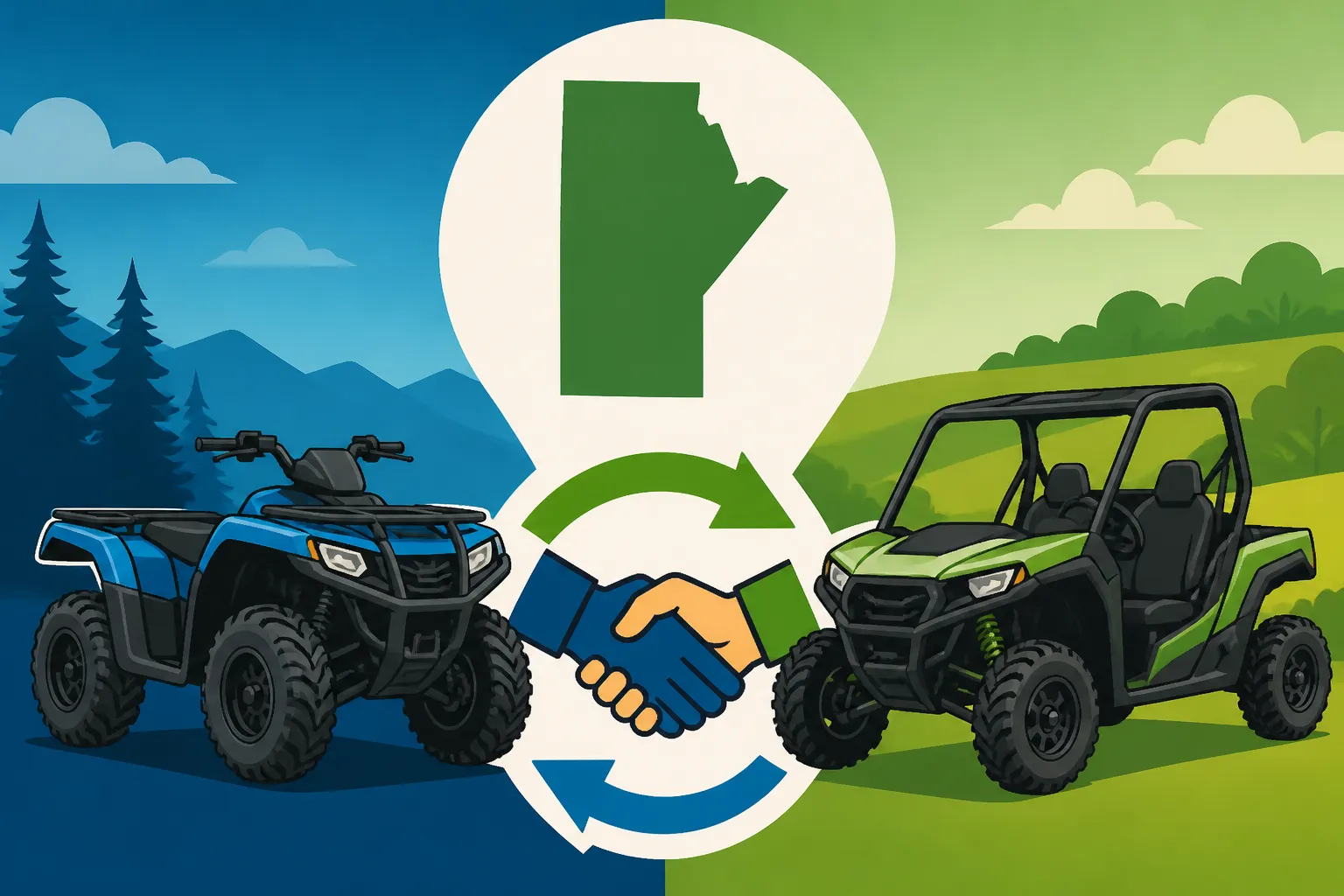
For off-road machines, the important practical point is that Manitoba’s trade groups may be broader than the names on the machines suggest. Quads and snowmobiles are treated as belonging to one trade group in the situations described by the applicable rules. Boats are a separate group, and cars and trucks are grouped apart from those recreational machines. The broad category, rather than the machine’s casual description, is what matters.
| What you trade | What you buy | What to check |
|---|---|---|
| Quad or ATV | Another quad or ATV | Confirm that the machines qualify within the same general kind |
| Quad or ATV | Snowmobile | Manitoba’s off-road trade grouping may allow this; confirm the specific transaction |
| Snowmobile | Quad or ATV | Check the trade-group treatment and how the dealer records the allowance |
| Boat | Quad or ATV | Boats are a separate trade group; do not assume the allowance qualifies |
| Car or truck | Quad or ATV | A road vehicle trade-in generally does not qualify as the same kind of trade |
| Cash from a private sale | Quad or ATV | Sale proceeds used as a down payment are not automatically a qualifying trade-in |
The table is a practical starting point, not a substitute for checking the exact classification of a particular machine. A side-by-side, amphibious machine, modified vehicle, or unusual model may not be described in a dealer’s system the same way you describe it. Ask the dealer to explain which trade group it is using and how that affects the RST calculation. For more on the categories, see Manitoba Trade-In Groups Explained.
The “same general kind” rule is about tax treatment, not whether the dealer will accept the machine. A dealer can decide whether to take a vehicle in trade based on its condition, resale potential, and business practices. Acceptance by the dealer does not, by itself, prove that the trade qualifies for an RST reduction.
Likewise, a trade can qualify as the same general kind without the old and new machines being identical. A two-wheel ATV and a four-wheel ATV, or one brand of quad traded for another brand, might be more similar for this purpose than a quad traded for a truck. But the dealer should confirm the classification rather than relying on an informal comparison.
How an eligible trade-in changes the tax calculation
When a trade-in qualifies, the allowance is generally applied against the purchase price before RST is calculated on the taxable balance. In other words, the trade can reduce the value on which the provincial tax is charged. It does not necessarily remove every other tax or fee from the transaction, and it is not the same thing as a cash rebate.
Here’s a simple illustration. Suppose the new machine’s selling price is $15,000 and the dealer allows $6,000 for an eligible trade. The basic amount remaining after the trade allowance is $9,000. The dealer would use the applicable rules to determine the taxable amount and the taxes for the transaction. The example shows the basic trade-in effect only; it does not represent a quote or a tax calculation for a real purchase.
The key distinction is between the trade allowance and the rest of the deal:
- Selling price: The amount charged for the machine you’re buying.
- Eligible trade allowance: The dealer’s stated value for the machine you’re trading, if it qualifies.
- Taxable balance: The amount used for the relevant tax calculation after applying eligible credits and any other required adjustments.
- Other charges and taxes: Items such as freight, accessories, documentation charges, or other amounts may be treated separately under the applicable rules.
Read the invoice line by line. A quote that shows a lower amount to finance is not enough to establish that the trade reduced the RST base. The lower balance could reflect a deposit, cash down, a promotional discount, or another financing adjustment. Ask the dealer to show the selling price, trade allowance, RST calculation, and any other taxes separately.
Manitoba RST is a provincial tax, and the tax calculation can be affected by how the transaction is structured. For background on who collects the tax and when, see Manitoba RST Collected at Registration. For the order in which provincial and federal taxes are calculated, see Manitoba RST Calculated Before GST. If the invoice’s tax lines do not make sense, ask the dealer to explain them before signing.
A trade allowance is not always the same as the machine’s retail value, advertised value, or private-sale price. A dealer sets its offer based on its own assessment and business costs. You can negotiate the trade value, the purchase price, or both, but it helps to compare the full transaction rather than focusing on one number. A larger trade allowance may be offset by a higher selling price, while a lower allowance might come with a better purchase price. The amount financed and the tax calculation should be checked alongside the headline trade figure.
Do not assume that every discount works like a trade-in. A dealer discount or manufacturer offer may reduce the selling price, but it is treated according to the rules that apply to that type of adjustment. A trade-in is a separate transaction: you are transferring one machine to the dealer as part of the purchase of another. Ask how the dealer has classified each adjustment and whether it changes the taxable amount.
Which ATV and UTV trades may qualify
For a typical ATV buyer, the most useful question is whether the outgoing and incoming machines fit within the same general trade group. Manitoba’s rules include quads and snowmobiles in one group for trade-in purposes, so a quad-for-snowmobile or snowmobile-for-quad transaction may be treated differently from a boat-for-quad or truck-for-quad trade. See [Manitoba Snowmobiles Traded on a Quad] for that specific comparison.
A UTV or side-by-side needs a little more care. People often use “ATV” as a catch-all for several types of off-road machines, but tax categories may rely on the vehicle’s actual classification, not the word used in a sales conversation. Before counting on a trade-in credit, ask the dealer to identify how both machines are classified and whether the trade is considered the same general kind.
Consider asking these questions before you agree to the deal:
- What category or trade group is the machine I’m trading in?
- What category or trade group is the machine I’m buying?
- Does the trade qualify for an RST reduction under the same-general-kind rule?
- What trade allowance will appear on the bill of sale?
- What amount will the dealer use to calculate RST?
- Is the quote showing a trade-in allowance, a cash down payment, a discount, or a combination?
- If the machine has a loan or lien, how will the payout be shown?
A dealer may describe a machine as a quad, UTV, side-by-side, utility vehicle, or off-road vehicle. Those labels help identify what you own, but the dealer’s tax classification is the one to verify for the transaction. If the machine is unusual, imported, modified, or difficult to identify from its paperwork, raise that issue before accepting the quote.
The same principle applies if the trade involves two different types of recreational machines. The fact that both are used for outdoor recreation does not automatically make them the same general kind. The trade groups are not based simply on how an owner uses the machine. If a boat, trailer, utility vehicle, or other equipment is part of the deal, ask whether it is included in the eligible trade allowance or listed separately. A trailer may have its own registration and tax considerations; it should not be assumed to share the machine’s classification.
If the dealer says an ATV-to-ATV trade qualifies, ask for the answer to appear clearly in the paperwork. If the dealer says a particular combination does not qualify, ask which classification or rule explains the decision. A clear answer before delivery is easier to act on than a surprise after the contract has been signed.
Dealer trade-in, private sale, and cash down are not interchangeable
The tax treatment depends on what actually happens in the transaction. A qualifying trade-in is generally part of the purchase deal: the dealer accepts your old machine and applies an allowance to the purchase of the new one. Selling your machine privately and using the cash as a down payment is not automatically the same arrangement.
For example, suppose you sell a quad to a neighbour, deposit the money, and then visit a dealer to buy another quad. The money may reduce what you need to borrow, but it does not become a dealer trade-in simply because it came from selling a similar machine. A deposit or cash down payment changes the financing balance; it does not necessarily reduce the amount used for the RST calculation.
A direct private transaction can also involve its own tax and registration steps. A buyer may have to deal with tax when registering a privately purchased machine, and the amount used for that calculation may depend on the applicable valuation rules. For the distinction between dealer transactions and private sales, see Manitoba Private Purchases Taxed at Registration.
This is why it can be misleading to compare two offers using only the cash difference. A dealer might offer a trade allowance and handle the transfer as part of the purchase. Another dealer might offer a different trade value or structure the sale differently. A private sale could bring in more money, but it also means arranging the sale, completing the ownership transfer, and dealing with the purchase and tax process separately.
Compare the alternatives with the same set of figures:
- The new machine’s selling price.
- The dealer’s written trade allowance.
- The tax calculation with the trade included.
- Any tax or other charges that apply if you sell privately and buy separately.
- Any loan payout needed to clear a lien on the old machine.
- The net amount you would actually keep from a private sale after completing the sale and paying off any debt.
If you’re choosing between an eligible dealer trade and a private sale, request an itemized quote for the trade-in option. Then calculate the private-sale option using the likely sale proceeds and the tax treatment that applies to a separate purchase. Do not compare the dealer’s trade allowance directly with a private-sale asking price; the amounts may not be equivalent after tax, loan payout, and transaction costs are considered.
A dealer may also offer to buy your machine outright rather than take it as a trade-in. Ask whether the offer is being recorded as a separate purchase or as a trade that is part of your new-machine transaction. The description in the documents matters. A cash purchase from the dealer followed by a separate purchase of another machine may not receive the same tax treatment as an accepted trade-in.
How a lien, negative equity, or multiple machines can affect the deal
An outstanding loan does not automatically make a trade-in impossible, but it changes the amount you receive from the transaction. The dealer may need to obtain a payout amount from the lender and arrange to clear the lien. The trade allowance and the loan balance are separate numbers, so do not treat the full allowance as cash you can use until you know how the lien will be handled.
If the dealer’s trade allowance is more than the loan payout, the remaining amount is equity. The paperwork should make clear how that equity is credited toward the new purchase. If the loan payout is greater than the trade allowance, there is negative equity. That shortfall may be handled in different ways depending on the agreement and financing, but rolling debt into a new loan does not turn the old debt into an additional trade-in allowance.
For example, a dealer might offer $6,000 for a machine while the lender’s payout is $7,500. The trade allowance is still the stated amount for the machine; the difference is a separate shortfall to resolve. Ask how that amount is treated in the sale contract and in the tax calculation. Do not assume that a larger loan on the new machine means the old machine’s trade value has increased.
When there is a lien, ask for:
- The trade allowance shown separately from the lender payout.
- Confirmation of how the lien will be discharged.
- A clear statement of any shortfall or equity.
- The amount, if any, being added to the new financing.
- An explanation of whether the tax calculation uses the trade allowance or another figure.
If the machine is owned jointly, make sure the people whose signatures are required are available and that the ownership documents match the names on the transaction. A mismatch between the owner, the registration, and the person signing the trade paperwork can delay the deal. See Manitoba Registration With Two Owners for more on ownership records.
If you are trading more than one machine, make sure the dealer lists each one separately. A bundle price can make it hard to see whether every machine was accepted as a qualifying trade or whether one was assigned a separate purchase value. Ask which trade group applies to each machine and which amount is being credited against the new purchase.
If one item in the bundle is a trailer, boat, or other equipment, ask whether it is being treated as part of the machine trade or as a separate item. The label “package deal” does not settle the tax classification. Keep a copy of the detailed agreement so you can see what was traded, what was purchased, and how each amount was recorded.
Paperwork to review before accepting a trade-in quote
Tax treatment is only one reason to read the documents carefully. A trade transfers ownership, and incomplete or inconsistent paperwork can create problems after the new machine is delivered. Before signing, make sure the description of the machine being traded matches the machine you are handing over, including its vehicle identification number, or VIN, where applicable.
The dealer’s paperwork should identify the old machine, the agreed trade allowance, and how that allowance is applied. It should also show the new machine’s price and the relevant tax lines. If the transaction includes financing, review the loan documents separately from the bill of sale. The amount you borrow is not a substitute for the transaction details.
Check these items:
- Owner information: The registered owner or owners are identified correctly, and required signatures are included.
- Machine identification: The make, model, year, and VIN or serial number match the machine being transferred.
- Trade allowance: The agreed amount is shown as a trade-in rather than only as a general credit or down payment.
- Purchase price: The new machine’s price is stated before the trade is applied.
- Tax lines: RST and other taxes are shown clearly, with the calculation explained.
- Loan payout: Any lien payout, equity, or shortfall is set out separately.
- Delivery and transfer terms: The documents explain when the old machine is transferred and when the new machine is delivered.
If you are buying from a dealer, the dealer should explain what paperwork it will complete and what you need to provide. See Manitoba Dealer Paperwork at Delivery for related purchase documents. A dealer’s verbal assurance is useful, but the figures and terms in the signed documents are what you will need to review later if there is a disagreement.
Bring the ownership and loan information for the machine you are trading. If you cannot find the registration certificate, bill of sale, or lien details, tell the dealer early. Missing ownership records can affect whether the dealer can accept the machine and complete the transfer. For a purchase where documents are incomplete, Manitoba Registration Without a Bill of Sale explains why the paperwork can matter.
Keep copies of the final bill of sale, trade-in agreement, tax calculation, loan documents, and any lender payout confirmation. If you notice that the stated trade allowance differs from what you negotiated, or that the tax calculation does not reflect the treatment the dealer promised, ask for a correction before you sign or take delivery.
Common trade-in mistakes and how to avoid them
Treating a down payment as a trade-in
A cash deposit, personal loan, or proceeds from a private sale can reduce the balance you finance, but that does not automatically make it an eligible trade. Ask whether the dealer is accepting your machine as a trade-in and showing its allowance on the purchase documents.
Assuming all vehicles belong to one trade group
“Vehicle” is an everyday umbrella term, not a guarantee of tax eligibility. A quad, truck, boat, snowmobile, or trailer may be placed in a different trade group. Check the exact combination rather than reasoning from the fact that both items have engines or wheels.
Relying on the trade value alone
A generous trade allowance is not always the best overall deal. Compare the selling price, trade allowance, taxes, and financing together. If the new machine’s price is higher than a comparable offer, a bigger trade figure may not improve the final cost.
Confusing trade value with equity
The trade allowance is the amount the dealer assigns to the old machine. Equity is what remains after any loan payout. Negative equity is a shortfall, not an increase in the machine’s value. Keep each number separate when reviewing the contract.
Assuming the dealer’s approval settles every tax question
A dealer may agree to accept the machine but still need to apply the tax rules to the trade. If the eligibility of the combination is unclear, ask the dealer to explain its classification and verify the answer before completing the transaction.
Waiting until delivery to raise a problem
Once documents are signed and the old machine is transferred, fixing an error can be more complicated. Review the invoice and trade agreement before accepting delivery. If a promised credit or tax treatment is missing, ask for it to be corrected in writing.
Forgetting that a trade is also an ownership transfer
A tax-eligible trade still requires a valid transfer of the old machine. Make sure the ownership information, signatures, VIN, and lien handling are correct. The deal should identify exactly what you are transferring and when.
The safest approach is to get an itemized written quote, confirm that the machines are treated as the same general kind, and check that the trade allowance appears in the tax calculation. If the classification is uncertain, do not rely on a verbal guess or a generic “vehicle trade” description. Ask the dealer to clarify the treatment and, when needed, confirm the rule with the appropriate Manitoba tax authority before committing.
Frequently Asked Questions
Can I trade a snowmobile for an ATV in Manitoba?
Manitoba’s off-road trade grouping treats quads and snowmobiles together in the situations described by the rules. Confirm the classification of the specific machines and how the dealer will record the transaction before relying on an RST reduction.
Does selling my ATV privately and using the money as a down payment count?
Not automatically. Sale proceeds used as cash down are different from a machine accepted by a dealer as a qualifying trade-in. A private sale and a later purchase may have separate tax and registration steps.
Can I trade a truck toward a UTV and reduce the RST?
Do not assume so. Road vehicles and off-road machines may fall into different trade groups. Ask the dealer to explain the classification and show how it affects the tax calculation.
Does an outstanding loan prevent a trade-in?
Not necessarily. The dealer may need to arrange a lender payout and clear any lien. The allowance, loan payout, equity or shortfall, and tax calculation should be shown as distinct figures.
Disclaimer
This article is for general informational purposes only and does not constitute professional advice. Laws, prices and regulations vary by location and change over time. Consult a qualified professional for guidance on your specific situation.