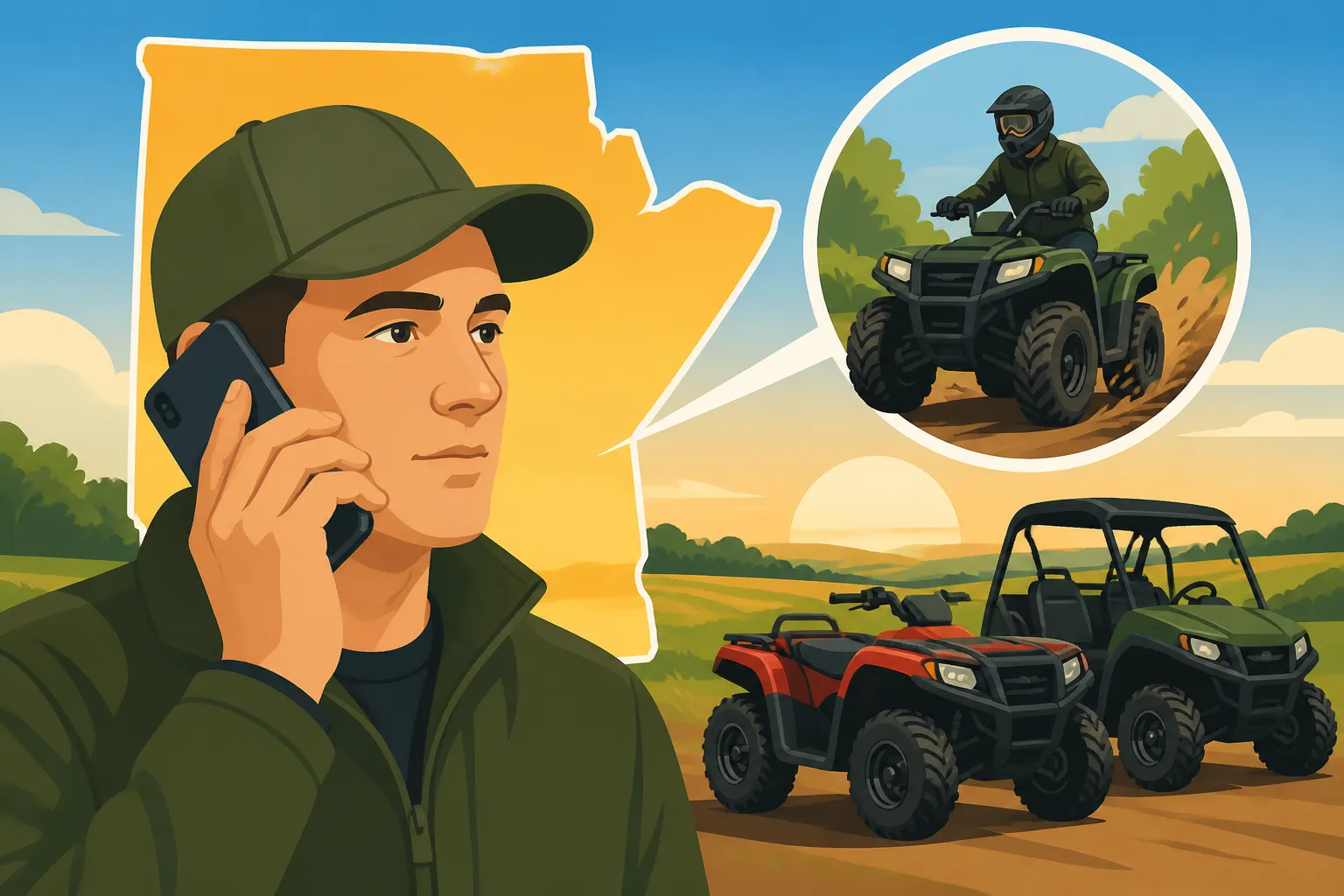
A Lease Holder Reached by Phone in Manitoba
A Crown lease can look like open riding country, but public ownership does not necessarily mean you can cross or ride anywhere on it. Reaching the lease holder before you unload gives you a chance to confirm permission, boundaries and conditions. The challenge is identifying the right person and asking clear questions before your trip.
Why a Crown lease holder’s permission matters
Crown land and land held under a Crown lease are not always treated the same way for access. A lease can give an occupant specific rights to use or manage an area. That means a route that appears to be public land may cross a leased parcel, a grazing area or ground the lease holder is responsible for. Do not assume that seeing Crown land on a map means every route across it is open to motorized recreation.
Before entering leased land, ask the lease holder for consent. The practical details matter too: permission for one road or trail does not automatically mean permission to explore the entire lease. A landholder may agree to a particular route while asking you to avoid livestock, crops, buildings, gates or sensitive ground. For the wider legal and access context, see Manitoba Crown Lease Access Rules and Consent From a Crown Lease Holder.
This is separate from your machine’s registration and any park permit that might apply to another part of your trip. Registration does not grant access to a lease, and permission to cross a lease does not replace registration or other operating requirements. Check the access question and the paperwork question independently. [Manitoba Crown Land Access Rules] explains the access side; Manitoba ORV Registration Through MPI covers registration.
A lease holder’s permission is also not a substitute for checking local restrictions. A route may cross a municipal area, a provincial park or land with a temporary closure. Confirm the whole route, not just the point where you expect to meet the lease boundary.
How to find and reach the right lease holder
Start with the exact area you intend to ride. A broad question such as “Can we ride around the lake?” may be hard to answer if the lease holder does not know which shore, trail or access road you mean. Use a map to identify your starting point, planned route, destination and any gates or road crossings. Mark the approximate area where you think the lease begins, but treat your map as a planning aid rather than proof of the boundary.
If you cannot identify the lease holder, ask a relevant local office or land contact which route to use for an access inquiry. Explain that you are trying to confirm permission for a specific trip across Crown lease land. You may need to provide a location description or map pin so the person can direct you to the correct contact. Avoid sharing private contact details publicly or relying on an old number passed around in a group chat.
When you call, introduce yourself, give the date or general timing of the ride, and describe the machine and group. Be ready to answer questions such as how many machines are coming, whether you are travelling through or stopping, and whether you plan to bring a trailer or passengers. A concise description helps the lease holder make a practical decision.
If the call goes to voicemail, leave your name and number, the proposed riding date, the location and the specific access you are requesting. Give the person time to respond. If you do not receive clear permission, do not treat silence as approval. Change the route, delay the ride or seek another place where access is confirmed.
Make the location easy to identify
Useful details include:
- A map pin or coordinates, if you can provide them reliably.
- The nearest road, community, lake or recognizable landmark.
- The entry point and the direction you plan to travel.
- Whether you plan to use an existing trail, lease road or another route.
- Where you expect to leave the leased area.
- Any gates, cattle guards or other boundary features on the route.
Do not assume a fence or gate precisely marks the legal lease boundary. Ask the lease holder how to identify the approved route and where you should turn around. If the answer is unclear, ask for a map, a marked route or a description you can repeat back.
A simple call checklist
Before calling, write down the essential details so you do not have to improvise:
- Identify the area and proposed access point.
- State the date or expected time period.
- Explain that you are requesting ATV or UTV access, not merely checking whether the land is Crown land.
- Give the number and type of machines in your group.
- Ask whether the route is allowed and what restrictions apply.
- Repeat the permission and conditions back to confirm you understood them.
What to ask before you ride
A useful request is specific enough for the lease holder to say yes, no or yes with conditions. Ask whether the group may use the route on the date proposed, whether the permission covers the full group, and whether it applies to both ATVs and UTVs. If you plan to return by a different route, ask about that separately.
Clarify the boundaries of the permission. You might be allowed to travel through a narrow corridor but not to ride elsewhere on the lease. Ask whether you may stop, camp, fish or retrieve game in the area; those activities should not be assumed to be included in permission to pass through. If your plans change, check again rather than extending the original agreement by assumption.
Ask about conditions that affect the land and the people using it. There may be livestock, active farm work, a seasonal closure, soft or wet ground, or a route that is unsuitable at that time. Ask whether to close a gate behind you, whether any gates must remain untouched, and how to avoid disturbing animals or damaging the track. If you are told not to enter a section, mark it on your group’s map and make sure everyone understands.
| Ask about | Why it matters |
|---|---|
| The approved entry and exit points | Permission may apply only to a particular route. |
| Boundaries and prohibited areas | A lease can include areas that are not part of the agreed route. |
| Gates and livestock | The lease holder may need gates managed in a particular way and animals left undisturbed. |
| Timing and ground conditions | A route may be unsuitable during certain work or weather conditions. |
| Group size and machine types | Consent for a small ATV group may not cover a larger group or UTVs. |
| Stops and other activities | Permission to cross does not necessarily include camping, fishing or game retrieval. |
| Changes to the plan | A different date, route or group may need renewed approval. |
Permission from one lease holder does not cover neighboring leases. If your route crosses several occupied areas, identify each one and obtain the required consent for each section. A single call may help you understand the route, but do not assume one person can authorize access beyond the land they manage.
Be ready to accept a refusal or a restricted route without arguing. A lease holder may have concerns about safety, property damage, current operations or past problems. If permission is not available, use another route. Riding around a gate or taking an unapproved shortcut can turn a straightforward trip into a trespass or land-damage dispute.
Keep permission clear and follow it on the ground
A phone conversation can be useful, but it is easy for two people to remember different details. Before ending the call, summarize what you understood: the route, date, group size, permitted machines and any restrictions. Ask whether the lease holder is comfortable with you keeping a written note of the agreement. If they offer a map or written confirmation, save it where the group can access it.
Your note should record:
- The date and time of the conversation.
- The name of the person who gave permission, if provided.
- The route or area approved.
- The dates or time period covered.
- Any conditions, including gate instructions and areas to avoid.
- Any follow-up contact information.
This record is not a replacement for consent, and it does not expand the permission. It simply helps you remember what was agreed and explain it to the other riders. Share the conditions with the whole group before leaving the staging area, not after someone has already ridden ahead.
On the day, follow the agreed route and ride in a way that avoids unnecessary disturbance. Stay away from crops, livestock, buildings, yards and gated rangeland unless the lease holder has expressly said otherwise. Crops and Gated Rangeland Off Limits and Manitoba Sensitive Areas to Avoid offer additional context on areas riders should take care to avoid.
Respect signs and barriers. Do not move a gate, cut a fence or create a new trail because the planned route is blocked. Stop and contact the lease holder if conditions have changed or you cannot identify the approved route. If you cannot reach them, turn back or use a route with confirmed access.
Access conditions can change after you have received permission. A road may become muddy, a gate may be closed for livestock or work may be underway. Permission to ride on one occasion is not automatically ongoing permission for later trips. For a repeat ride, confirm that the same route and conditions still apply.
Finally, check other rules that may affect the trip. Local restrictions, park rules, fire conditions and registration requirements are separate from a lease holder’s consent. Before driving a long distance, verify local access and any applicable closures using reliable, current information. Checking a Municipal By-Law Before a Long Drive and Manitoba Wildfire Season Rules for Riders can help you check those separate issues.
Disclaimer
This article is for general informational purposes only and does not constitute professional advice. Laws, prices and regulations vary by location and change over time. Consult a qualified professional for guidance on your specific situation.