Manitoba Fire Ban Lookups
If you’re planning an ATV or UTV ride in Manitoba, a fire ban can change what you’re allowed to do—and a fire restriction is not always the same as a trail or area closure. Check the right notices before you haul, then check again if conditions change. Here’s how to find the relevant information and tell a fire ban from a riding restriction.
Where to check Manitoba fire restrictions
Start with the Manitoba government’s online fire restrictions map. It is the central place to check provincial fire restrictions, but don’t treat one map as a complete answer for every place you might ride. Restrictions can depend on who manages the land, and a local authority may issue a separate notice.
For a ride on provincial Crown land or a provincial park route, check the applicable provincial notices as well as the map. Manitoba Wildfire Service updates can help you understand current wildfire activity and restrictions. If your route enters a municipality or northern community, check with the relevant local authority, too. A local restriction may apply within its boundaries even when a provincial notice looks different.
For a club trail, check the club’s current trail information. A trail may be closed because of fire danger, damage, maintenance or another operational concern, even when there is no general fire ban. Similarly, a map showing no fire restriction does not confirm that every route is open to off-road vehicles. See Manitoba Park Trail Closures for the separate question of access in provincial parks.
Use this sequence before leaving:
- Identify the land and route. Note the trailhead, the route you plan to ride and any communities or land types you will cross. A route can pass through more than one authority’s area.
- Check the provincial fire restrictions map. Look for notices covering your destination and any areas along the route. Read the notice itself rather than relying only on a colour or map symbol.
- Check local notices. Contact or check the website or social channels of the municipality, community, park office or trail club responsible for the area.
- Check for area closures and wildfire updates. A travel closure is different from a fire ban, but it may be the more important restriction for your ride.
- Confirm again before unloading. Conditions and orders can change. A screenshot from an earlier day is useful as a record of what you checked, but it does not establish that the same restriction is still in effect.
If the online map is difficult to interpret, call the office responsible for the land or ask the local trail club which authority to contact. Be specific: give the trailhead or route name, not just the nearest town. An answer about one area may not apply a few kilometres farther along a route.
The distinction between fire restrictions and riding access matters. Manitoba Wildfire Season Rules for Riders covers the broader responsibilities riders may need to consider during wildfire season, while [Manitoba Area Closure Orders] is relevant when travel itself may be restricted.
A fire ban is not always a riding ban
The words “fire ban,” “fire restriction” and “area closure” can appear together in wildfire notices, but they do not necessarily mean the same thing.
A fire ban generally limits activities that could start a fire, such as lighting an open fire. The exact activities covered depend on the order. Some notices may address specific equipment or activities, so read the full wording rather than assuming that a restriction applies only to campfires.
A travel or area closure limits access to a place or movement through it. If an area is closed to travel, a pass, club membership or registration does not automatically authorize you to ride there. Follow the closure notice and do not use a trail just because it appears on an older map.
A trail closure may be narrower still. A club or land manager may close a route because of conditions on the ground, even if the surrounding region has no general travel closure.
| Notice type | What it may restrict | What to check |
|---|---|---|
| Fire ban or fire restriction | Fires and other activities listed in the order | The exact prohibited activities and the area covered |
| Area or travel closure | Entry or movement through a defined area | The closure boundary, start time and any stated exceptions |
| Trail closure | A particular route or trail system | The club or land manager’s current trail notice |
| Equipment requirement | The use or condition of specified equipment | The wording of the requirement and which machines it covers |
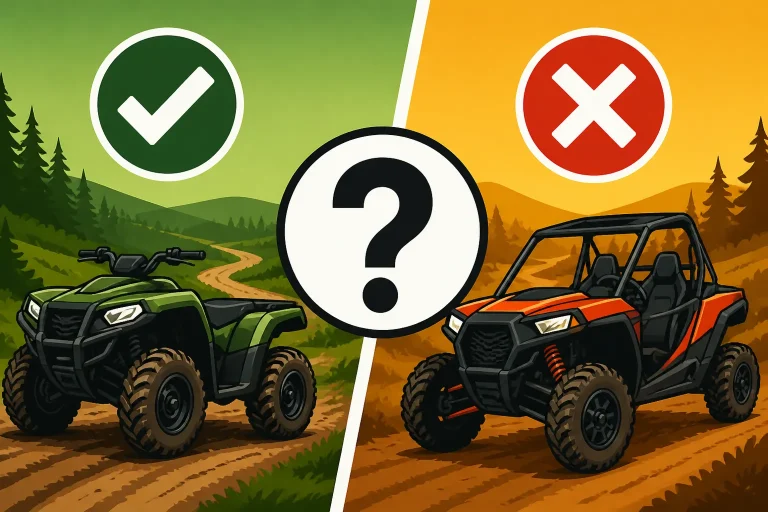
A fire ban does not automatically tell you whether an ATV route remains open. But an open route does not mean you can ignore the fire rules. You may be allowed to ride while being prohibited from lighting a campfire, for example. Conversely, a fire restriction might not be in place, but a travel closure can still make the route off limits.
That is why checking only a provincial fire map is not enough when the real question is, “Can I ride this route today?” Check the fire notice and the access notice separately. The process in Manitoba Fire Season Riding Restrictions can help clarify that distinction.
Permits and reciprocity do not override emergency restrictions. A park permit, home-province registration or club permission may address one requirement, but it does not cancel a fire order or grant access to closed land. Visitors should follow the Manitoba rules that apply to the area they enter, as well as any valid restrictions issued there.
What ATV and UTV riders should do during restrictions
Before a ride, read the notice for its location, timing and terms. A short headline may leave out details that matter, such as whether a restriction applies to a specific area, a specific activity or a wider region. If the boundary is unclear, ask the issuing authority rather than guessing from a nearby road or community name.
Pay particular attention to equipment language. A fire order may restrict certain activities or equipment because of ignition risk. Separately, Manitoba has requirements related to spark arresters; a fire ban does not make those requirements optional. Check Manitoba Spark Arrester Checks for more on what riders should be prepared to verify.
A careful fire-season routine includes:
- Inspect the machine before riding. Look for damaged wiring, leaking fuel or oil, and debris around hot parts. Make sure required safety equipment is present and in working order.
- Know the restrictions on fires and smoking. Do not assume that a small cooking fire, portable appliance or smoking activity is allowed. The written order controls.
- Avoid parking in dry vegetation. A hot exhaust or other hot component can create a hazard. Choose a clear, appropriate place to stop and follow any posted instructions.
- Carry water and basic recovery supplies. These do not replace compliance or firefighting equipment, but they can help with ordinary trail problems. Do not attempt to fight a wildfire; move away and report it.
- Keep your route flexible. If a road, trail or area is closed, turn around and use a route you have confirmed is open. Do not ride around a barrier or closure sign.
- Report smoke or fire promptly. Move to a safe place and contact emergency services or the appropriate wildfire authority. Give a clear location, such as a trail name, landmark or nearby access point.
A machine can be legal to operate and still create a fire risk if it is poorly maintained or used carelessly. Fire restrictions are not just about whether you can make a campfire; they are a reason to be especially cautious around dry grass, brush and hot components.
If your plan includes a campfire, check the fire rules separately from the riding rules. A firepit at a campsite or an established cooking area is not automatically exempt from an order. Follow the wording of the restriction and the instructions posted at the site. See Manitoba Burning Permits and Firepits for related considerations.
A practical lookup routine for visitors and local riders
A dependable lookup routine should cover the entire trip, not just the first trailhead. Riders sometimes travel across municipal boundaries or move from a club trail onto another type of land. Each change can bring a different authority or rule into the picture.
For a day ride, save the names and contact details of the land manager, trail club or local office before leaving. If cell service is limited, keep a paper map or an offline copy of the route information. An offline map can help with navigation, but it cannot tell you whether a restriction has changed since you downloaded it.
Use the following checklist:
- Before the trip: Check the provincial fire restrictions map, relevant local notices, trail status and any area closure orders.
- At the trailhead: Read posted signs. A sign may provide a more specific warning or closure than a general map view.
- During the ride: Respect barriers and new notices. If smoke, fire activity or changing conditions make the route unsafe, turn back.
- Before a campfire or cooking activity: Check the current order for the precise location and activity. Do not rely on what was allowed on a previous visit.
- After the ride: Report damaged signs, unsafe trail conditions or fire concerns to the responsible authority or club.
For visiting riders, a permit or registration from home does not answer every access question. It also does not provide an exemption from Manitoba fire restrictions. Confirm that your machine meets applicable operating requirements, then check the local fire and access notices for the route you intend to use. Manitoba Visitors and Operating Rules explains why visitors need to consider Manitoba’s operating rules, not only the requirements where their machine is registered.
When the map and a local notice appear to conflict, do not choose whichever one is more convenient. The notice may cover a narrower area or a more recent change. Contact the authority responsible for that specific land and ask which rule applies to your planned route. Until you have a clear answer, avoid the activity or area in question.
The key habit is simple: check fire restrictions, check access, and read the actual notice. A clear ride plan includes a backup route and a willingness to turn around. That approach helps prevent a fire-rule mistake from becoming a safety problem or a long haul to a closed trail.
Disclaimer
This article is for general informational purposes only and does not constitute professional advice. Laws, prices and regulations vary by location and change over time. Consult a qualified professional for guidance on your specific situation.